

Our Policies
Explore our policies on ESG, Quality Management, Anti-Bribery & Corruption, and our Code of Ethics. We believe in maintaining the highest standards of integrity, responsibility, and quality in everything we do.

ESG (Environmental, Social, & Governance) Policy
Updated on 11/07/2025
1.0 POLICY STATEMENT
At NSW Automation, we are committed to conducting our business in a responsible and sustainable manner. We recognize the importance of Environmental, Social, and Governance (ESG) factors in creating long-term value for our stakeholders, including employees, customers, shareholders, and the communities in which we operate. This ESG Policy outlines our commitment to integrating sustainability and ethical practices into our operations and decision-making processes.
2.0 Environmental Commitment
NSW is dedicated to minimizing our environmental impact and promoting sustainable practices. Our environmental commitments include:
Climate Action: Reducing greenhouse gas emissions and transitioning to renewable energy sources where feasible.
Resource Efficiency: Minimizing waste, conserving water, and improving energy efficiency across our operations.
Sustainable Sourcing: Prioritizing environmentally friendly materials and suppliers who adhere to sustainable practices.
Biodiversity Protection: Ensuring our operations do not harm ecosystems and supporting conservation efforts.
Compliance: Adhering to all applicable environmental laws and regulations and striving to exceed industry standards.
3.0 Social Responsibility
NSW is committed to fostering a diverse, inclusive, and equitable workplace and contributing positively to society. Our social commitments include:
Employee Well-being: Providing a safe, healthy, and supportive work environment for all employees.
Diversity, Equity, and Inclusion (DEI): Promoting diversity and inclusion at all levels of the organization and ensuring equal opportunities for all.
Community Engagement: Supporting local communities through philanthropy, volunteerism, and partnerships.
Human Rights: Respecting and upholding human rights in our operations and supply chain.
Customer Satisfaction: Delivering high-quality products and services that meet the needs of our customers while ensuring their safety and privacy.
4.0 Governance and Ethics
NSW is committed to maintaining the highest standards of corporate governance and ethical conduct. Our governance commitments include:
Transparency: Providing clear and accurate reporting on our ESG performance and progress.
Accountability: Establishing clear roles and responsibilities for ESG initiatives at the board and executive levels.
Ethical Business Practices: Conducting business with integrity, honesty, and fairness, and adhering to the laws, regulations, and a strict code of ethics.
Risk Management: Identifying and managing ESG-related risks to protect the company and its stakeholders.
Stakeholder Engagement: Regularly engaging with stakeholders to understand their concerns and incorporate their feedback into our decision-making processes.
5.0 Implementation and Monitoring
To ensure the effectiveness of this ESG Policy, we will:
Provide training and resources to employees to support ESG initiatives.
Conduct periodic reviews of this policy to ensure it remains relevant and effective.

Quality Policy
Updated on 11/07/2025
1.0 Commitment to Quality
Quality is integral to NSW Automation’s pursuit of our profession. We are convinced that quality is the core to the success of our business. The key elements of our approach imperative to Quality are based on the following Quality Principles.
2.0 Continuous Improvement
We are committed to the continuous improvement of our processes, products, and services, and to the effectiveness of our Quality Management System to fulfill the requirements of our stakeholders. We actively pursue ever-improving quality by setting clear quality objectives and execute plans towards excellence.
3.0 Engagement of People
Through our talent acquisition programs, we aim to motivate, engage, and empower our people to strengthen their competencies for the mutual benefits and growth of the individual and the company.
4.0 Relationship Management
We nurture mutually beneficial relationships with our stakeholders by committing to evolve culture, build partnerships, drive value, and satisfy business purposes.

Code of Ethics Policy
Updated on 11/07/2025
Statement of Our Core Values
Company Vision
To be the world leader in advanced precision dispensing solution.
Mission
We are passionate about delivering high performance and reliable precision liquid dispensing solution to support our customers’ automated dispensing needs.
Values
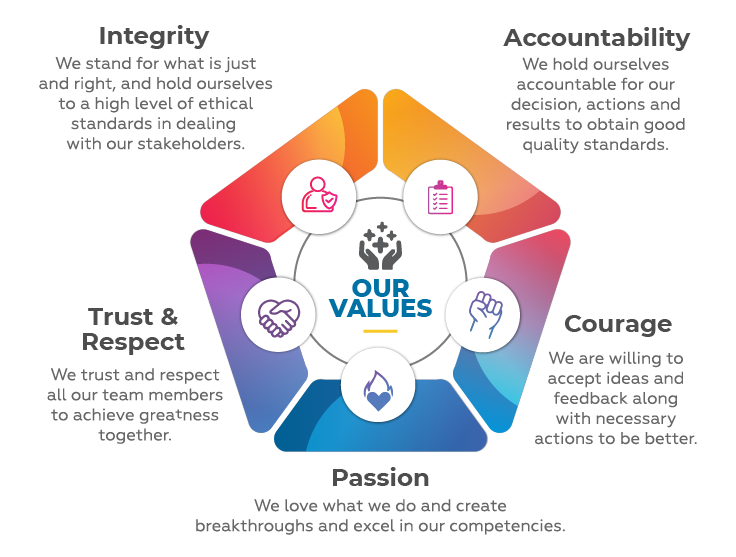
1.0 Conduct Business with Trust and Integrity
Lead By Example
Leaders has the added responsibility for demonstrating, through their actions, the importance of this Code. In any business, ethical behaviour does not simply happen; it is the product of clear and direct communication of behavioural expectations, modelled from the top and demonstrated by example. Again, ultimately, our actions are what matters.
To make our Code work, managers must be responsible for promptly addressing ethical questions or concerns raised by employees and for taking the appropriate steps to deal with such issues. Managers should not consider employees’ ethics concerns as threats or challenges to their authority, but rather as another encouraged form of business communication. At NSW Automation Sdn Bhd, we want the ethics dialogue to become a natural part of daily work.
Accountability
Each of us is responsible for knowing and adhering to the values and standards set forth in this Code and for raising questions if we are uncertain about company policy. If we are concerned whether the standards are being met or are aware of violations of the Code, we must contact the HR department.
NSW Automation Sdn Bhd takes seriously the standards set forth in the Code, and violations are cause for disciplinary action up to and including termination of employment.
Accurate Public Disclosures
We will make certain that all disclosures made in financial reports and public documents are full, fair, accurate, timely and understandable. This obligation applies to all employees, including all financial executives, with any responsibility for the preparation for such reports, including drafting, reviewing and signing or certifying the information contained therein. No business goal of any kind is ever an excuse for misrepresenting facts or falsifying records.
Employees should inform Executive Management and the HR department if they learn that information in any filing or public communication was untrue or misleading at the time it was made or if subsequent information would affect a similar future filing or public communication.
Corporate Recordkeeping
We create, retain and dispose of our company records as part of our normal course of business in compliance with all NSW Automation Sdn Bhd policies and guidelines, as well as all regulatory and legal requirements.
All corporate records must be true, accurate and complete, and company data must be promptly and accurately entered in our books in accordance with NSW Automation Sdn Bhd’s and other applicable accounting principles.
We must not improperly influence, manipulate or mislead any unauthorized audit, nor interfere with any auditor engaged to perform an internal independent audit of NSW Automation Sdn Bhd books, records, processes or internal controls.
Promote Substance Over Form
At times, we are all faced with decisions we would rather not have to make and issues we would prefer to avoid. Sometimes, we hope that if we avoid confronting a problem, it will simply go away. At NSW Automation Sdn Bhd, we must have the courage to tackle the tough decisions and make difficult choices, secure in the knowledge that NSW Automation Sdn Bhd is committed to doing the right thing. At times this will mean doing more than simply what the law requires. Merely because we can pursue a course of action does not mean we should do so.
Although NSW Automation Sdn Bhd’s guiding principles cannot address every issue or provide answers to every dilemma, they can define the spirit in which we intend to do business and should guide us in our daily conduct.
2.0 Uphold the Law
NSW Automation Sdn Bhd’s commitment to integrity begins with complying with laws, rules and regulations where we do business. Further, each of us must have an understanding of the company policies, laws, rules and regulations that apply to our specific roles. If we are unsure of whether a contemplated action is permitted by law or NSW Automation Sdn Bhd policy, we should seek the advice from the resource expert. We are responsible for preventing violations of law and for speaking up if we see possible violations.
Competition
We are dedicated to ethical, fair and vigorous competition. We will sell NSW Automation Sdn Bhd products and services based on their merit, functionality and safety, superior quality, competitive pricing and timely delivery. We will make independent pricing and marketing decisions and will not improperly cooperate or coordinate our activities with our competitors. We will not offer or solicit improper payments or gratuities in connection with the purchase of goods or services for NSW Automation Sdn Bhd or the sales of its products or services, nor will we engage or assist in unlawful boycotts of customers.
Proprietary Information
It is important that we respect the property rights of others. We will not acquire or seek to acquire improper means of a competitor’s trade secrets or other proprietary or confidential information. We will not engage in unauthorized use, copying, distribution or alteration of software or other intellectual property.
Selective Disclosure
We will not selectively disclose (whether in one-on-one or small discussions, meetings, presentations, proposals or otherwise) any material non-public information with respect to NSW Automation Sdn Bhd, its securities, business operations, plans, financial condition, results of operations or any development plan. We should be particularly vigilant when making presentations or proposals to customers to ensure that our presentations do not contain material non-public information.
Health and Safety
NSW Automation Sdn Bhd is dedicated to maintaining a healthy environment. A safety manual has been designed to educate you on safety in the workplace. If you do not have a copy of this manual, please see the HR department.
3.0 Respect for the Individual
One of the core values is to work as a team with Trust and Respect for each other. We strive to uphold open and honest communication and to protect employees from discrimination, harassment, or unsafe practise.
Build Trust and Credibility
The success of our business is dependent on the trust which created the confidence we earn from our employees, customers and stakeholders. We gain credibility by adhering to our commitments, displaying honesty and integrity and reaching company goals solely through honourable conduct. It is easy to say what we must do, but the proof is in our actions. Ultimately, we will be judged on what we do.
Create a Culture of Open and Honest Communication
At NSW Automation Sdn Bhd everyone should feel comfortable to speak his or her mind, particularly with respect to ethics concerns. Managers have a responsibility to create an open and supportive environment where employees feel comfortable raising such questions. We all benefit tremendously when employees exercise their power to prevent mistakes or wrongdoing by asking the right questions at the right times.
NSW Automation Sdn Bhd will investigate all reported instances of questionable or unethical behaviour. In every instance where improper behaviour is found to have occurred, the company will take appropriate action. We will not tolerate retaliation against employees who raise genuine ethics concerns in good faith.
Employees are encouraged, in the first instance, to address such issues with their direct superior or managers or the HR manager, as most problems can be resolved swiftly. If for any reason that is not possible or if an employee is not comfortable raising the issue with his or her manager or HR, NSW Automation Sdn Bhd’s Directors does operate with an open-door policy.
Respect for the Individual
We all deserve to work in a positive work environment where we are treated with dignity and respect. NSW Automation Sdn Bhd is committed to creating such an environment because it brings out the full potential in each of us, which, in turn, contributes directly to our business success. We cannot afford to let anyone’s talents go to waste.
NSW Automation Sdn Bhd is an equal employment/affirmative action employer and is committed to providing a workplace that is free of discrimination of all types and from abusive, offensive or harassing behaviour. Any employee who feels harassed or discriminated against should report the incident to his or her manager or to human resources executive and/or manager.
All NSW Automation Sdn Bhd employees are also expected to support an inclusive workplace by adhering to the following conduct standards:
▪ Always treat others with dignity and respect.
▪ Address and report inappropriate behaviour and comments that are discriminatory, harassing, abusive, offensive or unwelcome.
▪ Foster teamwork and employee participation, encouraging the representation of different employee perspectives.
▪ Seek out insights from employees with different experiences, perspectives and backgrounds.
▪ Avoid slang or idioms that might not translate across cultures.
▪ Support flexible work arrangements for co-workers with different needs, abilities and/or obligations.
▪ Confront the decisions or behaviours of others that are based on conscious or unconscious biases.
▪ Be open-minded and listen when others provide and/or give constructive feedback regarding their perception of your conduct.
NSW Automation Sdn Bhd will not tolerate discrimination, harassment or any behaviour or language that is abusive, offensive or unwelcome.
4.0 Avoid Conflicts of Interest
Conflicts of Interest
We must avoid any relationship or activity that might impair, or even appear to impair, our ability to make objective and fair decisions when performing our jobs. At times, we may be faced with situations where the business actions we take on behalf of NSW Automation Sdn Bhd may conflict with our own personal or family interests. We owe a duty to NSW Automation Sdn Bhd to advance its legitimate interests when the opportunity to do so arises. We must never use NSW Automation Sdn Bhd property or information for personal gain or personally take for ourselves any opportunity that is discovered through our designation with NSW Automation Sdn Bhd.
Stated below some other ways in which conflicts of interest could arise:
1. Being employed (you or a close family member) by, or acting as a consultant to, a competitor or potential competitor, supplier or contractor, regardless of the nature of the employment, while you are employed with NSW Automation Sdn Bhd.
2. Hiring or supervising family members or closely related persons.
3. Serving as a board member for an outside commercial company or organization.
4. Owning or having a substantial interest in a competitor, supplier or contractor.
5. Having a personal interest, financial interest or potential gain in any NSW Automation Sdn Bhd transaction.
6. Placing company business with a firm owned or controlled by a NSW Automation Sdn Bhd employee or his or her family.
7. Accepting gifts, discounts, favours or services from a customer/potential customer, competitor or supplier, unless equally available to all NSW Automation Sdn Bhd employees.
Determining whether a conflict of interest exists is not always easy to do. Employees with a conflict-of-interest question should seek advice from NSW’s management. Before engaging in any activity, transaction or relationship that might give rise to a conflict of interest, employees must seek review from their managers or the HR department.
Gifts, Gratuities and Business Courtesies
NSW Automation Sdn Bhd is committed to competing solely on the merit of our products and services. We should avoid any actions that create a perception that favourable treatment of outside entities by NSW Automation Sdn Bhd was sought, received or given in exchange for personal business courtesies. Business courtesies include gifts, gratuities, meals, refreshments, entertainment or other benefits from persons or companies with whom NSW Automation Sdn Bhd does or may do business. We will neither give nor accept business courtesies that constitute, or could reasonably be perceived as constituting, unfair business inducements that would violate law, regulation or policies of NSW Automation Sdn Bhd or customers, or would cause embarrassment or reflect negatively on NSW Automation Sdn Bhd’s reputation.
Accepting Business Courtesies
Most business courtesies offered to us in the course of our employment are offered because of our designation at NSW Automation Sdn Bhd. We should not feel any entitlement to accept and keep a business courtesy. Although we may not use our designation at NSW Automation Sdn Bhd to obtain business courtesies, and we must never ask for them, we may accept unsolicited business courtesies that promote successful working relationships and good will with the firms that NSW Automation Sdn Bhd maintains or may establish a business relationship with.
Employees who award contracts or who can influence the allocation of business, who create specifications that result in the placement of business or who participate in negotiation of contracts must be particularly careful to avoid actions that create the appearance of favouritism or that may adversely affect the company’s reputation for impartiality and fair dealing. The prudent course is to refuse a courtesy from a supplier when NSW Automation Sdn Bhd is involved in choosing or reconfirming a supplier or under circumstances that would create an impression that offering courtesies is the way to obtain NSW Automation Sdn Bhd business.
Meals, Refreshments and Entertainment
We may accept occasional meals, refreshments, entertainment and similar business courtesies that are given with the person who has offered to pay for the meal or entertainment, provided that:
▪ They are not inappropriately lavish or excessive.
▪ The courtesies are not frequent and do not reflect a pattern of frequent acceptance of courtesies from the same person or entity.
▪ The courtesy does not create the appearance of an attempt to influence business decisions, such as accepting courtesies or entertainment from a supplier whose contract is expiring in the near future.
▪ The employee accepting the business courtesy would not feel uncomfortable discussing the courtesy with his or her manager or co-worker or having the courtesies known by the public.
Gifts
Employees may accept unsolicited gifts, other than money, that conform to the reasonable ethical practices of the marketplace, including:
▪ Flowers, fruit baskets and other modest presents that commemorate a special occasion.
▪ Gifts of nominal value, such as calendars, pens, mugs, caps and t-shirts (or other novelty, advertising or promotional items).
Generally, employees may not accept compensation, honoraria or money of any amount from entities with whom NSW Automation Sdn Bhd does or may do business. Tangible gifts (including tickets to a sporting or entertainment event) that have a market value greater than RM50 may not be accepted unless approval is obtained from management.
Employees with questions about accepting business courtesies should talk to their managers or the HR department.
Offering Business Courtesies
Any employee who offers a business courtesy must assure that it cannot reasonably be interpreted as an attempt to gain an unfair business advantage or otherwise reflect negatively upon NSW Automation Sdn Bhd. An employee may never use personal funds or resources to do something that cannot be done with NSW Automation Sdn Bhd resources. Accounting for business courtesies must be done in accordance with approved company procedures.
Other than to our government customers, for whom special rules apply, we may provide nonmonetary gifts (i.e., company logo apparel or similar promotional items) to our customers. Further, management may approve other courtesies, including meals, refreshments or entertainment of reasonable value, provided that:
▪ The practice does not violate any law or regulation or the standards of conduct of the recipient’s organization.
▪ The business courtesy is consistent with industry practice, is infrequent in nature and is not lavish.
▪ The business courtesy is properly reflected on the books and records of NSW Automation Sdn Bhd.
5.0 Protect Company Assets and Intellectual Properties
Confidential and Proprietary Information
Integral to NSW Automation Sdn Bhd’s business success is our protection of confidential company information, as well as non-public information entrusted to us by employees, customers and other business partners. Confidential and proprietary information includes such things as pricing and financial data, customer names/addresses or non-public information about other companies, including current or potential supplier and vendors. We will not disclose confidential and non-public information without a valid business purpose and proper authorization.
Use of Company Resources
Company resources, including time, material, equipment and information, are provided for company business use. Nonetheless, occasional personal use is permissible as long as it does not affect job performance or cause a disruption to the workplace. Employees and those who represent NSW Automation Sdn Bhd are trusted to behave responsibly and use good judgment to conserve company resources. Managers are responsible for the resources assigned to their departments and are empowered to resolve issues concerning their proper use. Generally, we will not use company equipment such as computers, copiers and fax machines in the conduct of an outside business or in support of any religious, political or other outside daily activity, except for company-requested support to non-profit organizations. We will not solicit contributions nor distribute non-work-related materials during work hours. In order to protect the interests of the NSW Automation Sdn Bhd network and our fellow employees, NSW Automation Sdn Bhd reserves the right to monitor or review all data and information contained on an employee’s company-issued computer or electronic device, the use of the Internet or NSW Automation Sdn Bhd’s intranet. We will not tolerate the use of company resources to create, access, store, print, solicit or send any materials that are harassing, threatening, abusive, sexually explicit or otherwise offensive or inappropriate. Questions about the proper use of company resources should be directed to your manager.
Media Inquiries
NSW Automation Sdn Bhd is a high-profile company in our community, and from time to time, employees may be approached by reporters and other members of the media. In order to ensure that we speak with one voice and provide accurate information about the company, we should direct all media inquiries to the Marketing or Human Resources Executives. No one may issue a press release without first consulting with the Marketing or Human Resources Executives.
Reminders
The Code serves as our guide for conduction business with integrity. It is not an employment contract and confers no right relating to employment. The Code is not a complete list of company rules and regulation. The employees are expected to know and comply with all company rules and regulation related to the job. Violation of these guideline s may result in discipline, up to and including termination of employment. NSW Automation Sdn Bhd may amend the code from time to time deems necessary or appropriate.

Anti Bribery and Anti-Corruption Policy
Updated on 11/07/2025
1.0 Introduction
1.1
Anti-Bribery and Anti-Corruption policy (“ABAC Policy”) sets out an avenue where legitimate concerns on malpractice, unethical behaviours, misconduct, wrongdoings, bribery, corruptions, fraud, misuse of NSW Automation’s property, abuse of powers, conflict of interest, non-compliances to various policies and/or procedures violation of laws and regulations, can be objectively investigated and addressed. Individuals should be able to raise concerns about illegal, unethical, questionable practices in confidences and without the risk of reprisal.
1.2
The policy requires compliance with all applicable laws and regulations on bribery and corruption as such in, Subsection (5) of Section 17A of the Malaysian Anti-Corruption Commission Act 2009 (Act 694) (“MACC Act 2009”), as stated in the Malaysian Anti-Corruption Commission (Amendment) Act 2018 (“MACC Amendment Act 2018”).
2.0 Policy Statement
2.1 NSW Automation Sdn Bhd (hereinafter referred to as “NSWA”, “Company”, “Our”, “We” or “Us”) is committed to conducting business ethically and honestly and has zero-tolerance for bribery and corrupt activities. We are committed in all business dealings and relationship and will constantly uphold all laws relating to anti-bribery and anti-corruption in Malaysia, in particular, the Malaysia Anti-Corruption Commission Act 2009 (“MACC Act”).
2.2 This Anti-Bribery and Anti-Corruption Policy (hereinafter referred to as this “ABAC Policy”) has been developed as part of the Company Policy to align with the requirements set out in the Company’s direction of high integrity principles.
3.0 Policy Purpose
3.1 To ensure compliance with anti-bribery and anti-corruption laws and regulations.
3.2 To provide guidance of recognition and handling of bribery and corruption(s).
3.3 Promote ethical business conduct among employees, directors, contractors, business partners and other stakeholders.
4.0 Policy Scope
4.1 This ABAC Policy applies and is prescribed to be adopted to the Company and its controlled organisations, the Board of Directors and including all Employees (whether foreign worker, temporary, contract-basis or permanent or internship), partners, Directors, and associates of the Company or any other person or persons associated with the Company or its Employees, no matter where they are located (within or outside of Malaysia) (hereinafter collectively referred to as “Associated Persons”). The definition of such persons associated with the Company accords with Section 17A of the MACC Act.
4.2 This ABAC Policy sets out the minimum standards to which all Employees of the Company must always adhere to.
4.3 Although this ABAC Policy is specifically written for the Associated Persons, the Company expects that all parties engaged by the Company or performing work or services for or on behalf of the Company will comply with it in relevant part when performing such work or services.
4.4 Any arrangements the Company makes with a third party is subject to clear contractual terms, including specific provisions that require the third party to comply with minimum standards and procedures relating to anti-bribery and corruption laws or regulations.
5.0 Key Sections of the MACC Act 2009
5.1 This ABAC Policy applies to all countries worldwide, without exception and without regard to regional customs, local practices, or conditions. The Company is bound by the laws of Malaysia, particularly the MACC Act, in relation to our conduct both locally and abroad.
5.2 Kindly refer to Appendix 1 hereto for the key sections under the MACC Act.
6.0 Responsibilities of Stakeholders
6.1 Board of Directors / Synchronized Strategic Business Initiatives
6.1.1. Responsible for policy approval including any amendments to the Policy and overseeing the efficacy of this Policy’s implementation.
6.1.2. Enforcement of this policy and set the tone from the top.
6.2 Heads of Department
6.2.1. Set a precedent for ABAC compliance and eventually monitor bribery and corruptions concerns.
6.2.2. Responsible for the assurance of the compliance with the policy and relevant anti-corruption legislation by business associates, third parties and/or external stakeholders.
6.3 Human Resource Department
6.3.1. Responsible for the design, implementation, monitoring, and management of ABAC framework.
6.4 Middle-Management / Supervisory Role / Team Leader
6.4.1 Responsible for informing all staff members about the ABAC Policy and its obligations.
6.4.2 Responsible for ensuring the Company’s Code of Conduct, ABAC Policy and requirements are communicated to business partners, third parties, and/or external stakeholders,
6.5 Internal Audit Committee
6.5.1. Direct the Internal Audit function to conduct regular audit focusing on compliance with the ABAC Policy. This includes reviewing financial records, contracts
7.0 Definition
7.1 The Company will categorise the following terms to be applicable in this ABAC Policy for reference: –
“Bribery”
means any action which would be considered as an offence of giving or receiving ‘gratification’ under the MACC Act. In practice, this means offering, giving, receiving or soliciting something of value, in an attempt to illicitly influence the decisions or actions of a person who is in a position of trust within an organization.
“Corporate Gift”
means something given from one organization to another, with the appointed representatives of each organization giving and accepting the gift. The gifts are given transparently and openly, with the implicit or explicit approval of all parties involved. Corporate gifts normally bear the Company name and logo.
“Corruption”
means the act of soliciting, giving, promising to give, offering, accepting or receiving gratification, directly or indirectly, to/from a person in authority either in the form of money, services, favours, positions or valuable goods as an inducement or reward to or not to do an act in relation to the person’s principal affairs or function.
“Directors”
includes all independent and non-independent directors, executive and non-executive directors of the Company and shall also includes alternate or substitute directors.
“Employees”
means all individuals directly contracted to the Company on an employment basis, including permanent and temporary employees.
“Gratification”
is defined in Section 3 of the MACC Act and includes money, donation, gift, loan, fee, reward, valuable security, property or interest in property, employment, appointment, release, forbearance, undertaking, promise, rebate, discount, services employment or contract of employment or services and agreement to give employment or render services in any capacity. The provision or receipt of gratification is not an offence unless it is done corruptly.
8.0 Fighting Bribery, Corruption and Unethical Practices
8.1 Solicitation, Bribery and Corruption
8.1.1 All Associated Persons are not permitted to pay, offer, accept, or receive a bribe in any form. Associated Persons are strictly NOT allowed to: –
I. offer, pay or give anything of value to any parties in order to obtain business or anything of benefit to the Company;
II. act illegally including bribes, blackmail, inducements, secret commissions, other rewards, and similar improper actions;
III. attempt to induce any parties to do something illegal, unethical and permit any parties to violate the rules;
IV. give some advantage inconsistent with law and wrongful or unlawful use of official position to procure some benefit or personal gain;
V. corruptly give, promise, or offer to any person gratification with the intent to secure business or an advantage for the Company; or
VI. offer, give, receive, or solicit, directly or indirectly, anything of value to influence improperly the actions of another party.
8.2 Facilitation Payment
8.2.1 All Associated Persons are prohibited from, directly or indirectly, accepting or obtaining or attempting to accept or obtain or offering or attempting to offer facilitation payments from/to any person for themselves or for any other person subject to this ABAC Policy.
8.2.2 The term “facilitation payments” generally means payments made to secure or expedite the performance by a person performing a routine or administrative duty or function.
8.3 Prohibition on Commissions, Discounts and Secret Profits
8.3.1 All Associated Persons must not, directly, or indirectly, receive or obtain, in respect of any goods or services purchased or other business transacted (whether or not by them) by or on behalf of the Company, any discount, rebate, commission, service, interest, consideration of value or other benefit or payments of any kind (whether in cash or in kind) which is not authorised by the Company’s policies or procedures.
8.4 Receiving Gifts, Entertainment, Hospitality and Travel
8.4.1 All Associated Persons are required to comply with the Company’s Code of Conduct (CoC) or any other policy and procedures relating to the receipt of gifts and entertainment, including but not limited to the following: –
I. Offering or receiving any gifts, hospitality and sponsored travel that may be perceived to unfairly influence a business relationship must be strictly avoided at all times. They should only be provided and received where they are appropriate, consistent with reasonable business practice, and would not be perceived to have any improper influence on the recipient.
II. All Associated Persons should use good judgment in offering or receiving the above-mentioned. In determining whether a specific gift item lies within the bounds of acceptable business practice, Associated Persons are encouraged to discuss the issue with Human Resource Department (“HR”).
III. All Associated Persons must not request, accept, offer, or provide gifts or hospitality designed to induce, support or reward improper conduct in connection with any business or anticipated future business involving the Company.
IV. The offering or receiving any gifts, hospitality and sponsored travel must be done in an open and transparent manner.
V. Associated Persons must never avoid their obligation to report or seek approval for any business gift by paying personally for it in circumstances where they would otherwise be required to report and/or seek approval for it.
VI. All giving of Gifts, Hospitality and sponsored Travel must get necessary approval from Management and the Company.
VII. All receipt of Gifts, Hospitality and sponsored Travel must be updated to HR Department within 48 hours of receiving it or as soon as practically possible thereafter. All registration and/or declaration must be made in the Associated Persons’ best interests.
VIII. In addition, when giving and/or receipt of Gifts, Hospitality, sponsored travel, or any other benefit directly or indirectly to or by the Associated Persons, the Associated Persons must make sure that it: –
a. is aimed at nothing more than general relationship building;
b. could not be perceived as an attempt to gain influence in respect of any particular matter;
c. In compliance with local laws, rules and regulations; and
d. it is recorded and explained, in a proper and timely manner, in the Company’s records (e.g. gifts log/declaration, accounting records – the expense report).
8.5 Political Contributions, Sponsorships and Donations
8.5.1 Political Contributions
I. The Company does not make or offer monetary or in-kind political contributions to political parties, political party officials or candidates for political office. Any appearance of making such contributions or expenditure to any political party, candidate or campaign, must also be avoided.
8.5.2 Sponsorships and Donations
I. The Company’s Associated Persons must ensure that all sponsorships and donations are not used as a subterfuge for bribery or used to circumvent or avoid any of the provisions of the Managing Director, including, the prohibition on corruption and bribery.
II. In accordance with the Company’s commitment to contribute to the community coupled with its values of integrity and transparency, all sponsorships, and donations must comply with the following: –
a. ensure such contributions are allowed by applicable laws;
b. obtain all the necessary approval/authorisation;
c. be made to well-established entities with an adequate organisational structure to guarantee the proper administration of the funds;
d. be accurately stated in the Company’s accounting books and records.
9.0 Conflict of Interest
9.1 Conflicts of interest occurs when an individual or organisation is involved in multiple interests, one of which could possibly corrupt, or be perceived to corrupt, the motivation for an act in another. A conflict of interest may be actual, potential or perceived and may be financial or non-financial.
9.2 It is the responsibility of the Company and all Associated Persons, that any ethical, legal, financial, or other conflicts of interest be avoided and that any such conflicts (where they do arise) do not conflict with the obligations to the Company. The Company requires all Associated Persons to: –
I. avoid any situation or activity that compromises, or may compromise, their judgement or ability to act in the best interest of the Company;
II. avoid being in a position where their personal interests are in conflict (or could be in conflict) with the interests or business of the Company;
III. avoid engaging in activities that will bring direct or indirect profit, commercial or business advantages to the Company’s competitor;
IV. avoid acting in ways that may compromise the Company’s legality and reputation; and
V. identify and disclose any conflicts of interest.
9.3 Declaration of Conflicts of Interest
9.3.1 To avoid issues of probity relating to the Associated Persons, all real or potential situations of conflict of interest must be immediately reported to the Human Resources Department.
9.3.2 Associated Persons must complete and sign a declaration of conflict of interest which will be kept in their personal file. Any change in the personal situation of the Associated Persons regarding the Company that may lead to a conflict of interest must also be immediately reported to the Human Resources Department. This declaration shall be made mandatory to all Employees. The Human Resources Department should keep a record of any circumstances of actual or potential conflicts of interest.
10.0 Reporting of a Concern and Whistleblowing
10.1 If Associated Persons suspect that there is an instance of bribery or corrupt activity occurring in relation to the Company, Associated Person can make a report of their concern/complaint at the earliest opportunity so that corrective action can be taken as soon as possible. If they are uncertain about whether a certain action or behaviour could be considered bribery or corruption, they should speak to their Head of Department, the Human Resource Department or the Managing Director.
Please refer to “RED FLAG” scenarios as set out in Appendix 2 hereto.
10.2 Recognizing the aforementioned values, the Company will provide an avenue for all Associated Persons to disclose any improper conduct within the Company. The Company will ensure that no one suffers any detrimental action/treatment as a result of refusing to accept or offer a bribe or other corrupt activities or because they reported a genuine concern relating to potential act(s) of bribery or corruption in good faith, based on reasonable grounds and in accordance with the procedures in this ABAC Policy and the Company Whistleblowing Policy.
10.3 If anyone becomes aware of any actual or suspected breach of this ABAC Policy, they must report this to the designated whistleblowing channel immediately. The Company Associated Persons are not permitted to ignore, or fail to report, any suggestion of a corruption or bribe.
10.4 Proper investigation will be conducted followed by appropriate action taken (if any). The matters which may be reported under the Whistleblowing Policy include (but are not limited to): –
I. concerns about bribery and corruption;
II. concerns about any other criminal activities or failure to comply with legal obligations;
III. concerns about any conduct likely to compromise or damage the Company’s reputation;IV. concerns about possible money laundering or sanctions breaches; and/or
V. the deliberate concealment of any of the above matters.
10.5 If any of the Associated Persons have any doubts or queries regarding the application of this ABAC Policy, the Associated Persons may also contact the whistleblowing channel via HR Feedback Form.
11.0 Recruitment of Employees
11.1 The Company recognises the value of integrity in its Employees. The recruitment of Employees should be based on approved selection criteria to ensure that only the most qualified and suitable individuals are employed. This is crucial to ensure that no element of corruption is involved in the hiring of Employees. The Company does not offer employment to prospective Employee in return for their having improperly favoured the Company in a previous role.
12.0 Disciplinary Action
12.1 Disciplinary action will be taken against the Associated Person in the following instances: –
I. Any Associated Persons who violate the terms and conditions of this ABAC Policy;
II. Any Associated Persons have direct knowledge of potential violations of this ABAC Policy but fails to report such potential violations to the Company’s management or the Managing Director or designate;
III. Any Associated Persons who mislead or hinder investigators inquiring into potential violations of this ABAC Policy;
IV. Any third-party agent who violates the terms of this ABAC Policy, who knows of and fails to report to the Company’s management potential violations of this ABAC Policy, or who misleads investigators making inquiries into potential violations of this ABAC Policy, may have their contracts re-evaluated or terminated.
12.2 In all cases, disciplinary action may include termination of employment.
13.0 Record Keeping
13.1 The Company shall keep detailed and accurate financial and other records and shall have appropriate internal controls in place as evidence of all payments made. The Company shall report and keep a record of the amount and reason for gifts, hospitality and entertainment received and given, including donations, sponsorships and expenses of similar nature, and understand that such expenses are subject to the management review.
14.0 Associated Persons Responsibilities
14.1 The Company takes corruption and bribery very seriously. Any violation of this ABAC Policy will be regarded as serious matter by the Company and is likely to result in disciplinary action, including termination, consistent with local law.
14.2 Associated Persons shall ensure all their subordinates under their control are equally responsible for the prevention, detection and reporting of bribery and other forms of corruption. They are required to avoid any activities that could lead to, or imply, a breach of this ABAC Policy.
14.3 If Associated Persons have reasons to believe or suspect that an instance of bribery or corruption has occurred or will occur in the future that breaches this ABAC Policy, he/she must notify the compliance officer and/or the HR Department.
15.0 Associated Persons Declaration
15.1 Associated Persons shall certify in writing that they have read, have understood and will abide by this ABAC Policy, the Company’s Whistleblowing Policy and any other related policies. A copy of this ABAC Declaration shall be documented and retained by the Human Resources Department for the duration of the Employee and/or Personnel’s employment.
15.2 ABAC Declaration can be found in the Appendix 3 hereto.
16.0 Personal Data Protection
16.1 In accordance with the Personal Data Protection Act 2010 (PDPA) and its amendments, any personal data collected in connection with the implementation of this Anti-Bribery and Anti-Corruption Policy, including for the purposes of reporting, investigating, and managing suspected bribery or corruption incidents, will be processed in a lawful, fair, and transparent.
16.2 Personal data may be collected and processed from employees, vendor, agents, consultants, and business associates for purposes such as due diligence, background checks, investigations, compliance monitoring, and legal reporting.
16.3 All personal data shall be obtained and used lawfully, fairly, and with appropriate consent where required.
16.4 The Company ensures that personal data is protected against unauthorized access, alteration, disclosure, or loss through appropriate technical and organizational measures.
16.5 Data collected for ABAC purposed will only be retained for as long as necessary and in accordance with internal retention policy and applicable laws.
16.6 Individuals handling personal data under this Policy are responsible for safeguarding its confidentiality and must report any suspected breaches immediately to the Data Protection Offer (DPO).
17.0 Administration of the Policy
17.1 Requests for additional guidance or interpretation regarding this ABAC Policy can be directed to the SSBI (Synchronized Strategic Business Initiative).
17.2 Regular assessments of this ABAC policy should be carried out to ensure its scope, policies, procedures, and controls match the bribery and corruption related risks faced by the Company.
17.3 The Management reserves the right to amend, modify or update this ABAC Policy unilaterally at any time without notice.
17.4 This Policy is provided with both Bahasa Malaysia and English versions. In the event of any primary conflict or inconsistency between two versions, the English version shall prevail and be the primary reference.

Whistleblowing Policy
Updated on 11/07/2025
1.0 Introduction
1.1 NSW Automation Sdn Bhd hereinafter referred to the collectively as (“NSW Automation”, “the Company”, “Our”, “We” or “Us”), is committed to its business activities with honesty, integrity, law-abiding and the highest ethical standards in all business dealings with its employees, business associates, partners, governments, customers and suppliers/vendors. The Company is committed to a high standard of compliance, fair and impartial practices at all levels and departments of the Company.
1.2 This Whistleblowing Policy (hereinafter referred to as “WB”) serves as a guideline to encourage and allow the Associated Persons to raise legitimate complaints and/or concerns in relation to criminal activities or breach of a legal obligation including but not limited to negligence, breach of contract and contravention of the Company Anti-Bribery and Anti-Corruption Policy and the MACC Act (as defined hereunder) and to be objectively investigated and addressed within the Company.
2.0 Policy Scope
2.1 This policy applies to all individuals, including permanent employees, full-time employees, those on probation, and interns. We will ensure that our whistleblowing policy is communicated to agents, vendors, and contractors associated with Company so that they are aware of its existence and its role in preserving the company’s integrity, transparency, impartiality, and accountability.
2.2 The Whistleblowing Policy (WB) should be read in conjunction with the following policies: –
I. The Company’s Anti-Bribery and Anti-Corruption Policy; and
II. Employee Handbook
3.0 Definition
3.1 The Company will categorise the following terms to be applicable in this Whistleblowing Policy (WB) for reference: –
Associated Persons means the Company controlled organizations, the Board of Directors and including all Employees (whether temporary, contract-basis or permanent or internship), Directors, partners, and associates of the Company or any other person or persons associated with the Company or its Employees, no matter where they are located (within or outside of Malaysia)
“SSBI means the (Synchronized Strategic Business Initiative)”of the Company;
“Directors” includes all independent and non-independent directors, executive and non-executive directors of the Company and shall also include alternate or substitute directors;
“Employees” means all individuals directly contracted to the Company on an employment basis, including permanent and temporary employees;
“MACC Act” means Malaysian Anti-Corruption Commission Act 2009 (Act 694) and Malaysian Anti-Corruption Commission (Amendment) Act 2018 (Act A1567);
“Whistleblower” means an Associated Person who makes a disclosure of improper conduct / wrongdoing to the Human Resource Department;
“Whistleblowing” is the act of disclosing misconduct or wrongdoing;
“WPA 2010” Whistleblower Protection Act 2010 (Act 711).
4.0 Scope
4.1 This Whistleblowing Policy (WB) applies to all Associated Persons acting in good faith to raise concerns and are encouraged to report and/or disclose actual or potential wrongdoing or misconduct within the Company.
4.2 These wrongdoings or misconduct include but are not limited to: –
I. incidents of fraud, theft, embezzlement and/or misuse of company information and/or assets and/or resources;
II. taking or giving favours, solicitation and/or giving or accepting of bribes;
III. conduct which violates any law and regulatory obligation;
IV. acts that adversely affect the interests or values of Shareholders and Stakeholders;
V. unauthorised disclosure or sale of the Company’ information;
VI. falsification of reports or documents;
VII. improper or undesirable personal behaviour or misdeeds which seriously impact the Company’ business or reputation;
VIII. a situation which poses a danger to health, safety or any individual or significant danger to the environment;
IX. sexual or other forms of harassment in the workplace; and
X. attempts to cover any of the aforementioned and/or Appendix 1 hereto.
Kindly refer to the list of concerns as set forth in Appendix 1 hereto.
5.0 Reporting Procedure
5.1 Who can disclose?
The Whistle-blower can make a report of their concern/complaint at the earliest opportunity so that corrective action can be taken as soon as possible.
5.2 What to disclose?
The Whistle-blower can make a report if it relates to any wrongdoing/misconduct as stated in Section 4.2 above and/or Appendix 1 hereto and/or any wrongdoing/misconduct deemed to be detrimental to the Company.
The Whistleblowing Policy (WB) excludes grievances, disclosure or concerns or complaints concerning: –
I. matters which are trivial or frivolous or malicious in nature;
II. matters which are motivated by personal agenda or ill-will; and
III. matters pending or determined by the Company’s disciplinary action and/or any
tribunal/court/arbitration or other similar proceedings.
5.3 Whom does the Whistle-blower report to?
The monitoring and execution of this Whistleblowing Policy (WB) will be placed under the supervision of the Human Resource Department.
5.4 How to make a report / disclosure?
5.4.1 The Whistle-blower have the option to make whistleblowing report in strict confidential through any of the following channels: –
| Medium | Contact Details |
| Form | [Company Name] The form which is set out in Appendix 2 hereto. (Attn: Human Resource Department) |
| Electronic Email | wehearyou@nswautomation.com |
5.4.2
The Whistle-blower should disclose their contact information and the information of the concern as set out in Appendix 2 hereto. This will enable the Human Resource Department to accord the person making the whistleblowing report necessary protection under this Whistleblowing Policy (WB) and obtain more details pertaining to the whistleblowing report.
5.4.3
Any anonymous report will not be entertained. Any Whistle-blower who wishes to report wrongdoing/misconduct is required to disclose his/her identity to the Company in order for the Company to accord the necessary protection to him/her. Nonetheless, the Company reserves its right to investigate the anonymous report.
5.4.4
The Whistle-blower must have first-hand knowledge or information of the facts, i.e., information obtained from the third party or ‘hearsay’ will not be entertained. However, the Whistle-blower should not be discouraged from making a report because they are unsure whether there is sufficient evidence to support their allegations.
6.0 Investigation
6.1 Upon receipt of the whistleblowing form, Human Resource Department will screen and assess the report and will as soon as practicable establish a whistleblowing investigation team comprising appropriate and suitably qualified personnel to investigate the concerns disclosed in the whistleblowing report in a fair and objective manner and at its discretion.
6.2 The investigation by itself would not be tantamount to an accusation and is to be treated as a neutral fact-finding process. If the whistleblowing investigation team finds that the alleged wrongdoing or misconduct is true, the Company will take appropriate actions including disciplinary action, termination of contract and establishing new controls to prevent recurrence of the wrongdoing or misconduct in the Company.
6.3 Subject to the severity of the misconduct and/or wrongdoing, the initial investigation process may be completed immediately if the misconduct and/or wrongdoing is capable of causing irreparable damage to the Company. Similarly, additional time may be required, where necessary.
6.4 Human Resource Department will keep a record of all steps taken in response to each whistleblowing report received as well as how the concerns/complaints raised were resolved. Upon conclusion of the investigation, Human Resource Department will report their findings to the SSBI (Synchronized Strategic Business Initiative).
6.5 If the SSBI (Synchronized Strategic Business Initiative) are satisfied with the outcome of the investigation, it will communicate to management to proceed with action based on established policy for the necessary disciplinary action to be taken immediately. Instituting the disciplinary action will be the responsibility of the Company’s Human Resource Department. If the misconduct involves a breach of statutory provisions, the official report should be made to the relevant regulatory authorities.
6.6 The Management must also take into account recommendations contained in the investigation report to prevent the conduct from continuing or occurring in the future. The disciplinary/corrective actions to be taken may also be directed to remedy any harm or loss arising from the conduct.
7.0 Confidentiality
7.1 The identities of the Whistle-blower and the alleged wrongdoer and the whistleblowing report will be treated as confidential to the extent reasonably practicable so long as it does not impede or frustrate the investigation. However, in some circumstances, it may be obvious who has raised the concern and file the report, or the investigation process may lead to the point where a statement is required, or the individual is called to provide evidence.
7.2 In the event of being unable to maintain the anonymity of the Whistle-blower, additional measures will be considered within the rights of the Whistle-blower, such as leave of absence, temporary relocation and so forth.
8.0 Whistleblower Protection
8.1 Protection to the Whistle-blower will be accorded by the Company only when the Whistle-blower satisfies all the following conditions: –
I. The disclosure/report is done in good faith and is not petty or frivolous or vexatious or is not made with malicious intent or ulterior motive;
II. The Whistle-blower has disclosed his/her identity and contact information;
III. The Whistle-blower has not communicated the disclosure to any other party not related to the disclosure; and
IV. The disclosure made is not for personal gain or interest.
Upon making the disclosure, the Whistle-blower’s identity will be protected, i.e. kept confidential unless otherwise required by law or for purposes of any proceedings by or against the Company.
8.2 The Whistle-blower shall be protected from Detrimental Action (as defined hereunder) within the Company as a direct consequence of such whistleblowing report.
Definition of “Detrimental Action” under the WPA 2010 means: –
I. action causing injury, loss or damage;
II. intimidation or harassment;
III. interference with the lawful employment or livelihood of any person, including discrimination, discharge, demotion, suspension, disadvantage, termination or adverse treatment in relation to a person’s employment, career, profession, trade or business or the taking of disciplinary action; and
IV. a threat to take any of the actions referred to in paragraphs (a) to (c).
8.3 The Company will not discharge, discipline, demote, suspend, threaten, or in any manner discriminate the Associated Persons who submit in good faith a whistleblowing report or provides assistance to the Human Resource Department or any other person investigating such report.
8.4 The Associated Persons who become a Whistle-blower will also be protected by the Company as to his/her identity subject to the conditions fulfilled in Clause 8.1 above.
8.5 Notwithstanding the foregoing, the Whistle-blower should exercise due care to ensure that the information in their whistleblowing report is complete, accurate and truthful. This protection may be revoked if the Whistle-blower misuse or abuse this Whistleblowing Policy (WB) by making false, frivolous, malicious or vexatious allegations and the Whistle-blower shall be subject to disciplinary/corrective actions determined by the Human Resource Department which may include formal warning or reprimand, demotion, suspension or termination or other forms of actions deemed appropriate.
9.0 Personal Data Protection
9.1 In accordance with the Personal Data Protection Act 2010 (PDPA), any personal data collected through the whistleblowing process will be used solely for the purpose of managing and investigating the disclosure. The Company is committed to ensuring that all personal data is handled in a secure and confidential manner, and in compliance with applicable data protection laws. Access to such data will be restricted to authorized personnel only, and the identity of the whistleblower will be protected to the fullest extent as permitted by law.
9.2 The personal data collected will be retained only for as long as necessary to fulfil the purpose stated above, and in accordance with the Company’s data retention policy and applicable laws and regulations. Once the data is no longer required, it will be securely deleted or anonymized.
9.3 Individuals have the right to access and request correction of their personal data held by the Company. Any such request must be made in writing and submitted to the Company’s Data Protection Officer or designated person-in-charge.
10.0 Review of this Whistleblowing Policy and Procedures (WB)
10.1 The Company undertakes to review this Whistleblowing Policy (WB) from time to time and will take into consideration any feedback from the Associated Persons to improve it further.
10.2 This Policy is provided with both Bahasa Malaysia and English versions. In the event of any conflict or inconsistency between two versions, the English version shall prevail and be the primary reference.
10.3 The Human Resource Department and/or Legal Department can modify/update/amend this Whistleblowing Policy (WB) at any time without notice. Modification/amendment may be necessary, among other reasons, to maintain compliance with laws and regulation and/or accommodate organisational changes within the Company.